
Exploration of CSAPR-2 Z-R relationships over BNF
Overview
This notebook explores the relationship between radar reflectivity (Z) and rain rate (R) CSAPR2 radar over BNF. Accuracy of ZR relationship is affected by the variability of raindrop size distributions (DSDs). Rainfall also causes attenuation of radar signals, particularly at higher frequencies. This can also be used for rainfall estimation. The LDQUANTS is a laser disdrometer based product from ARM that characterizes DSD. We want to optimized the Z-R relationship over BNF, for more accurate rainfall estimations compared to using generalized or default Z-R relationships. This notebook will demonstrate the derivation of both Z-R and k-R (attenuation-rain rate) relationships using LDQUANTS data.
Prerequisites
| Concepts | Importance | Notes |
|---|---|---|
| Linear Regression | Necessary | |
| Radar Reflectivity | Necessary | |
| Understanding of NetCDF | Helpful | Familiarity with metadata structure |
Time to learn: 30 min.
System requirements:
Populate with any system, version, or non-Python software requirements if necessary
Otherwise use the concepts table above and the Imports section below to describe required packages as necessary
If no extra requirements, remove the System requirements point altogether
Z-R and k-R Relationships from LDQUANTS for BNF M1
The notebook presents an analysis to derive empirical relationships between radar reflectivity (dBZ) and rain rate (R), and also specific attenuation (k) and R using Drop Size Distribution (DSD) from LDQUANTS from NetCDF files.
imports and file reading
import xarray as xr
import numpy as np
import matplotlib.pyplot as plt
import seaborn as sns
import glob
file_dir = '/Users/bhupendra/projects/bnf-amf3/data/bnfldquantsM1.c1/'
file_pattern = 'bnfldquantsM1.c1.2025*.nc'
file_paths = sorted(glob.glob(file_dir + file_pattern))
print(len(file_paths))39
I will use xarray to read mutiple files
ds = xr.open_mfdataset(file_paths, combine='by_coords')
print(ds)
<xarray.Dataset> Size: 10MB
Dimensions: (time: 54412)
Coordinates:
* time (time) datetime64[ns] 435kB ...
Data variables: (12/42)
base_time (time) datetime64[ns] 435kB ...
time_offset (time) datetime64[ns] 435kB dask.array<chunksize=(1440,), meta=np.ndarray>
rain_rate (time) float32 218kB dask.array<chunksize=(1440,), meta=np.ndarray>
reflectivity_factor_sband20c (time) float32 218kB dask.array<chunksize=(1440,), meta=np.ndarray>
reflectivity_factor_cband20c (time) float32 218kB dask.array<chunksize=(1440,), meta=np.ndarray>
reflectivity_factor_xband20c (time) float32 218kB dask.array<chunksize=(1440,), meta=np.ndarray>
... ...
specific_differential_attenuation_cband20c (time) float32 218kB dask.array<chunksize=(1440,), meta=np.ndarray>
specific_differential_attenuation_kaband20c (time) float32 218kB dask.array<chunksize=(1440,), meta=np.ndarray>
specific_differential_attenuation_xband20c (time) float32 218kB dask.array<chunksize=(1440,), meta=np.ndarray>
lat (time) float32 218kB 34.34 ....
lon (time) float32 218kB -87.34 ...
alt (time) float32 218kB 293.0 ....
Attributes: (12/14)
command_line: ldquants -s bnf -f M1 -b 20250201 -e 20250202
Conventions: ARM-1.3
process_version: vap-ldquants-1.3-1.el7
dod_version: ldquants-c1-1.4
input_datastreams: bnfldM1.b1 : 1.6 : 20250201.000000
site_id: bnf
... ...
data_level: c1
location_description: Southeast U.S. in Bankhead National Forest (BNF), ...
datastream: bnfldquantsM1.c1
doi: 10.5439/1432694
pydsd_version: 1.0.6.2
history: created by user dsmgr on machine prod-proc3.adc.ar...
plots
We will make basic plots to get the idea of the data quality.
fig, axes = plt.subplots(1, 2, figsize=(15, 5))

ds['rain_rate'].plot.hist(ax=axes[0], bins=50, color='skyblue', edgecolor='black')
axes[0].set_xlabel(f' {'rain rate'} ({ds['rain_rate'].units})')

ds['reflectivity_factor_cband20c'].plot.hist(ax=axes[1], bins=50, color='skyblue', edgecolor='black')
axes[1].set_xlabel(f' {'reflectivity_factor_cband20c'} ({ds['reflectivity_factor_cband20c'].units})')

plt.show()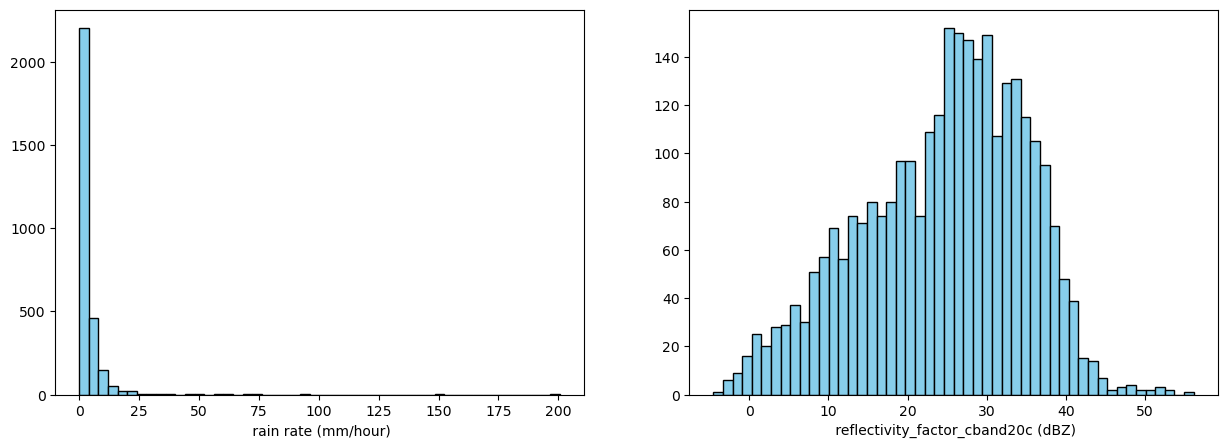
This looks as expected. There are some higher values of rain rates.
fig, axes = plt.subplots(2, 1, figsize=(12, 8), sharex=True)

ds['rain_rate'].plot(ax=axes[0], color='blue')
axes[0].set_title('Time Series of rain_rate')
axes[0].set_ylabel(f'{ds["rain_rate"].long_name} ({ds["rain_rate"].units})')

ds['reflectivity_factor_cband20c'].plot(ax=axes[1], color='blue')
axes[1].set_title('Time Series of reflectivity_factor_cband20c')
axes[1].set_ylabel(f'{ds["reflectivity_factor_cband20c"].long_name} ({ds["reflectivity_factor_cband20c"].units})')

plt.xlabel('Time')
plt.tight_layout()
plt.show()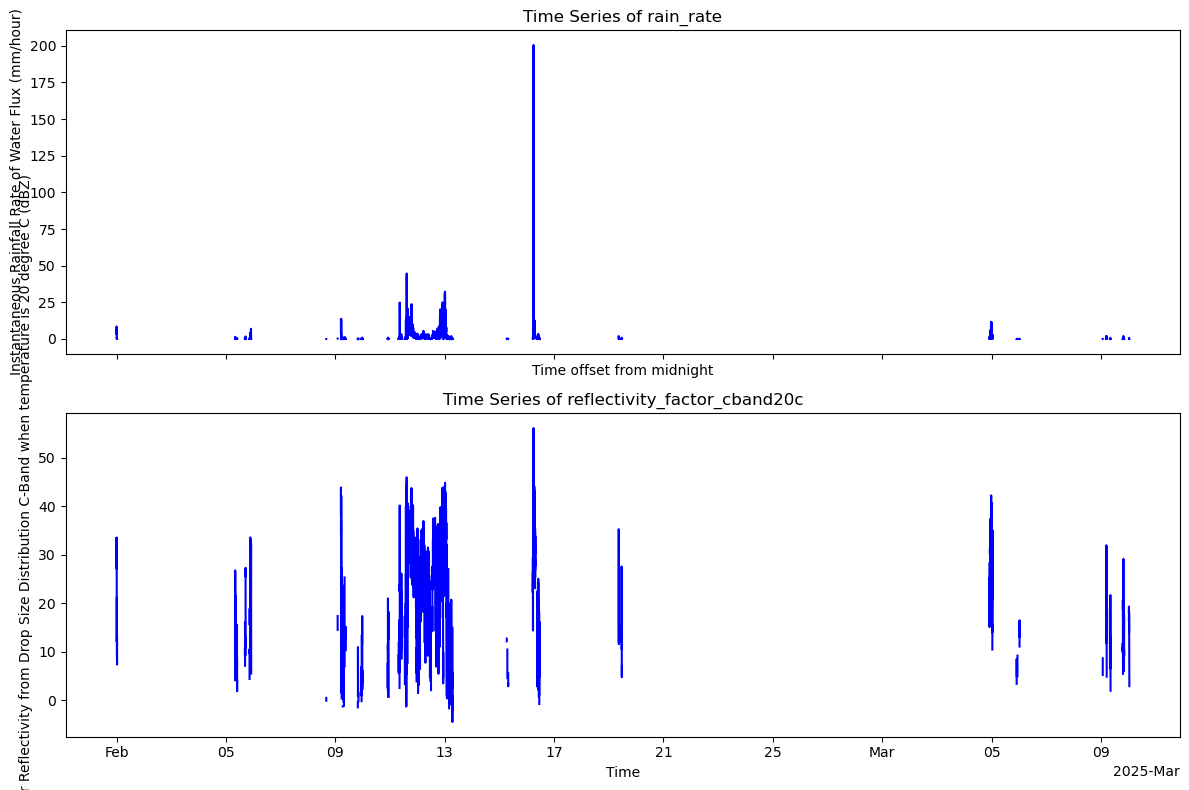
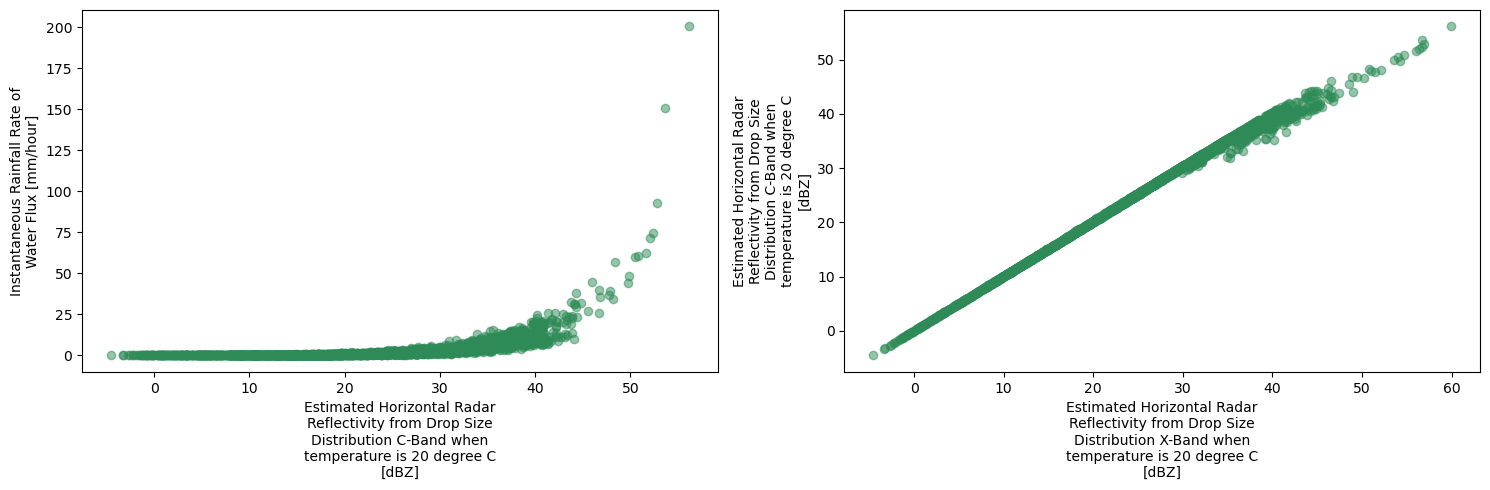
Some more plots. ZR plot is looking promising.
fig, axes = plt.subplots(1, 2, figsize=(15, 5))

ds.plot.scatter(x='reflectivity_factor_cband20c', y='rain_rate', ax=axes[0], alpha=0.5, color='seagreen')
ds.plot.scatter(x='reflectivity_factor_xband20c', y='reflectivity_factor_cband20c', ax=axes[1], alpha=0.5, color='seagreen')

plt.tight_layout()
plt.show()
Fitting ZR relationship
To find the coefficients a and b in the power-law relationship Z = a * R^b, we do linear regression in log-log space.
Take Log of both sides of the Z-R equation gives
log(Z) = log(a) + b * log(R)
# let me first remove bad values, as i think that is causing issues
rain_rate = ds['rain_rate'].values
reflectivity_dbz = ds['reflectivity_factor_cband20c'].values

valid_indices_zr = np.where(np.isfinite(rain_rate) & np.isfinite(reflectivity_dbz) & (rain_rate > 0)) # remove bad values
rain_rate = rain_rate[valid_indices_zr]
reflectivity_dbz = reflectivity_dbz[valid_indices_zr]
print(f"Min dBZ: {min(reflectivity_dbz)}")
print(f"Max dBZ: {max(reflectivity_dbz)}")Min dBZ: -4.522533893585205
Max dBZ: 56.1351432800293
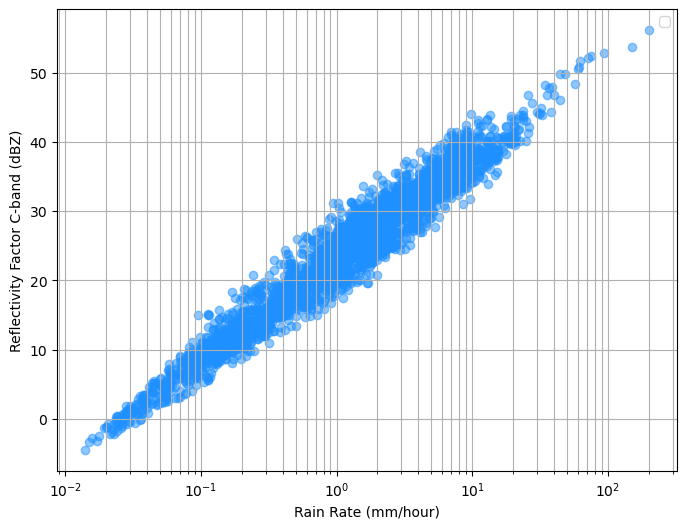
Plot Log-Log relationship
plt.figure(figsize=(8, 6))
plt.scatter(rain_rate, reflectivity_dbz, alpha=0.5, color='dodgerblue')
plt.xlabel('Rain Rate (mm/hour)')
plt.ylabel('Reflectivity Factor C-band (dBZ)')
plt.xscale('log') # Logarithmic scale for rain rate
plt.yscale('linear')
plt.grid(True, which="both", ls="-")
plt.legend()
plt.show()
No artists with labels found to put in legend. Note that artists whose label start with an underscore are ignored when legend() is called with no argument.
Z_linear = 10**(reflectivity_dbz / 10) # Z in mm^6 m^-3
log_Z = np.log10(Z_linear) # Take log10 of Z
log_R = np.log10(rain_rate) # Take log10 of rain rate
plt.plot(log_R, log_Z, 'o', color='blue', alpha=0.5)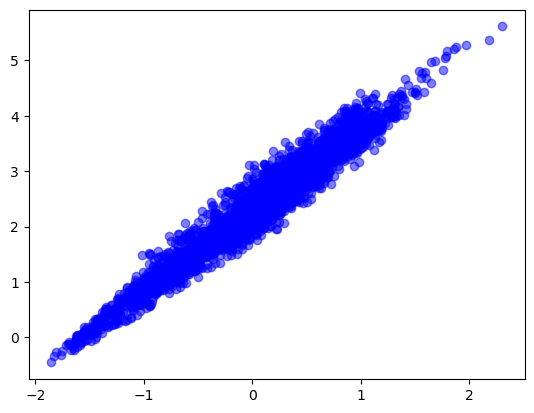
Linear regression
coefficients_zr = np.polyfit(log_R, log_Z, 1) # Linear fit: log(Z) = b*log(R) + log(a)
print(f"coefficients_zr (raw from np.polyfit): {coefficients_zr}")
b_coefficient = coefficients_zr[0] # Slope
log_a_coefficient = coefficients_zr[1] # Intercept
a_coefficient = 10**log_a_coefficient # Convert to a

print(f"Z-R Relationship for C-band (from LDQUANTS data):")
print(f"Z = {a_coefficient:.2f} * R**{b_coefficient:.2f}") # Z = a * R^b
coefficients_zr (raw from np.polyfit): [1.46141458 2.33188229]
Z-R Relationship for C-band (from LDQUANTS data):
Z = 214.72 * R**1.46
plt.figure(figsize=(8, 6))
plt.scatter(rain_rate, reflectivity_dbz, alpha=0.5, color='dodgerblue')
plt.xlabel('Rain Rate (mm/hour)')
plt.ylabel('Reflectivity Factor C-band (dBZ)')
plt.xscale('log') # Logarithmic scale for rain rate
plt.yscale('linear')
plt.grid(True, which="both", ls="-")

# Add the fitted Z-R line
rain_rate_line = np.logspace(np.log10(min(rain_rate)), np.log10(max(rain_rate)), 100)
Z_linear_line = a_coefficient * (rain_rate_line**b_coefficient)
reflectivity_dbz_line = 10 * np.log10(Z_linear_line)
plt.plot(rain_rate_line, reflectivity_dbz_line, color='blue', linewidth=2, label=f'Fitted Z-R: Z={a_coefficient:.2f}*R**{b_coefficient:.2f}')

plt.legend()
plt.show()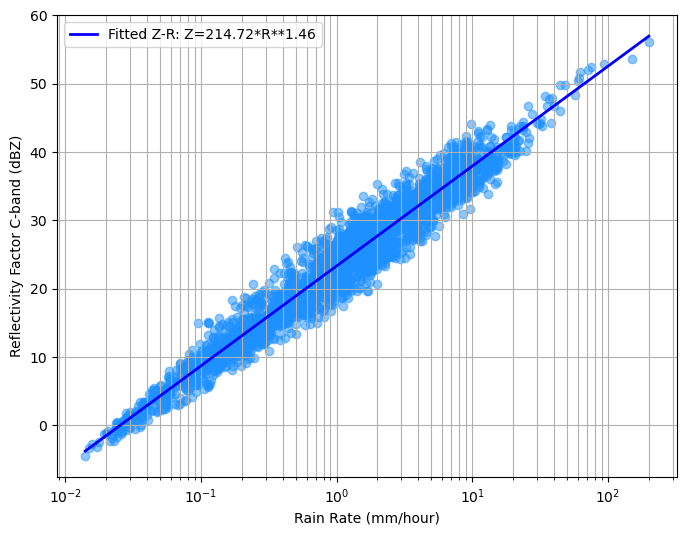
Now this is correct!
Now we will do the same for Attenuation
rain_rate = ds['rain_rate'].values
specific_attenuation = ds['specific_attenuation_cband20c'].values

valid_indices_kr = np.where(np.isfinite(rain_rate) & np.isfinite(specific_attenuation) & (rain_rate > 0)) # remove bad values or it will cause iisues
rain_rate = rain_rate[valid_indices_kr]
specific_attenuation = specific_attenuation[valid_indices_kr]
print(f"Min specific_attenuation (dB/km): {min(specific_attenuation)}")
print(f"Max specific_attenuation (dB/km): {max(specific_attenuation)}")
Min specific_attenuation (dB/km): 3.992306665168144e-05
Max specific_attenuation (dB/km): 0.9515843391418457
plt.figure(figsize=(8, 6))
plt.scatter(rain_rate, specific_attenuation, alpha=0.5, color='coral')
plt.xlabel('Rain Rate (mm/hour)')
plt.ylabel('Specific Attenuation C-band (dB/km)')
plt.xscale('log')
plt.yscale('log')
plt.grid(True, which="both", ls="-")
plt.legend()
plt.show()
No artists with labels found to put in legend. Note that artists whose label start with an underscore are ignored when legend() is called with no argument.
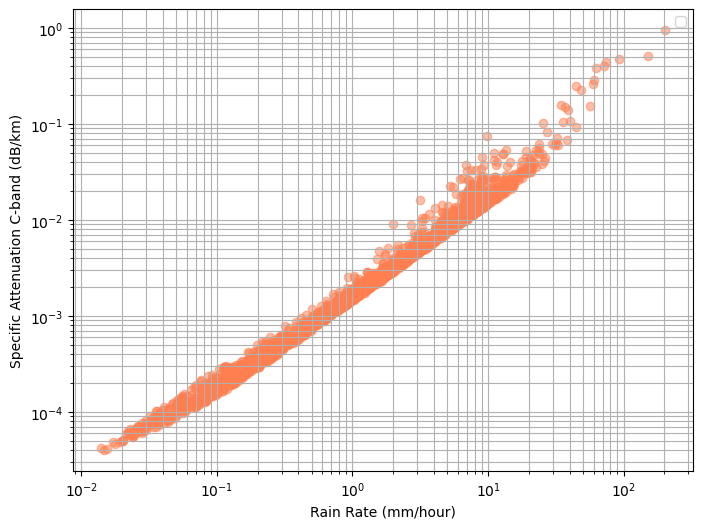
log_R_k = np.log10(rain_rate)
log_k = np.log10(specific_attenuation)
coefficients_kr = np.polyfit(log_R_k, log_k, 1) # Linear fit: log(k) =d*log(R) + log(c)
print(f"coefficients_kr (raw from np.polyfit): {coefficients_kr}")
d_coefficient = coefficients_kr[0] # Slope is d
log_c_coefficient = coefficients_kr[1] # Intercept
c_coefficient = 10**log_c_coefficient # Convert to c

print(f"k-R Relationship for C-band (from LDQUANTS data)")
print(f"k = {c_coefficient:.3f} * R**{d_coefficient:.3f}") # k= c * R**d
coefficients_kr (raw from np.polyfit): [ 0.99072717 -2.76246926]
k-R Relationship for C-band (from LDQUANTS data)
k = 0.002 * R**0.991
Let’s check it.
plt.figure(figsize=(8, 6))
plt.scatter(rain_rate, specific_attenuation, alpha=0.5, color='coral')

rain_rate_fit_kr = np.linspace(min(rain_rate), max(rain_rate), 100)
attenuation_fit = c_coefficient * (rain_rate_fit_kr**d_coefficient)

plt.plot(rain_rate_fit_kr, attenuation_fit, color='red',
         linewidth=2, label=f'Fitted k-R: k={c_coefficient:.3f}*R**{d_coefficient:.3f}')

plt.ylabel('Specific Attenuation C-band (dB/km)')
plt.title('k-R Relationship derived from LDQUANTS (C-band) data')
plt.xscale('log')
plt.yscale('log')
plt.grid(True, which="both", ls="-")
plt.legend()
plt.xlim(min(rain_rate)*0.8, max(rain_rate)*1.2)
plt.ylim(min(specific_attenuation)*0.8, max(specific_attenuation)*1.2)
plt.show()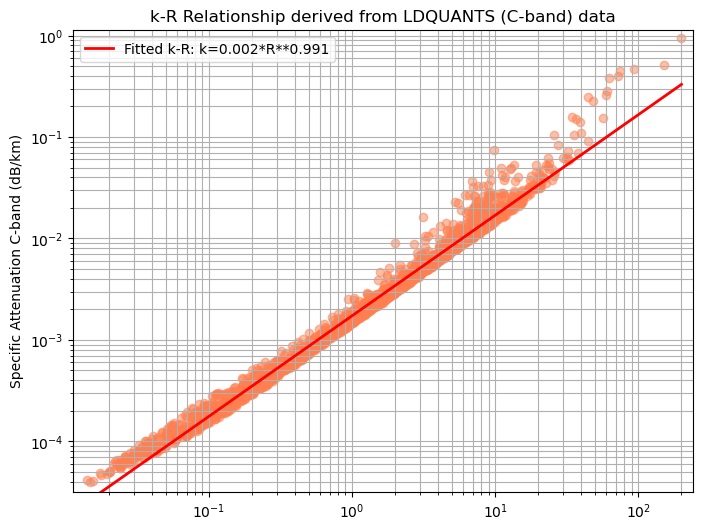
Because the one rain event was mainly convective the attenuation relationship was looking better, however it has issues with higher rain rates.