
Bankhead National Forest - Evaluation of RadClss
Overview
The Extracted Radar Columns and In-Situ Sensors (RadClss) Value-Added Product (VAP) is a dataset containing in-situ ground observations matched to CSAPR-2 radar columns above ARM Mobile Facility (AMF-3) supplemental sites of interest.
RadCLss is intended to provide a dataset for algorthim development and validation of precipitation retrievals.
This notebook utilizes months of processed RadCLss data for an evaluation of the precipitation fields within CMAC
Prerequisites
| Concepts | Importance | Notes |
|---|---|---|
| Intro to Cartopy | Necessary | |
| Understanding of NetCDF | Helpful | Familiarity with metadata structure |
| GeoPandas | Necessary | Familiarity with Geospatial Plotting |
| Py-ART / Radar Foundations | Necessary | Basics of Weather Radar |
Time to learn: 30 minutes
import warnings
warnings.filterwarnings("ignore", category=DeprecationWarning)

import os
import glob
import datetime

import numpy as np
import matplotlib.pyplot as plt
import xarray as xr
import pandas as pd
import dask
import cartopy.crs as ccrs

from math import atan2 as atan2
from cartopy import crs as ccrs, feature as cfeature
from cartopy.io.img_tiles import OSM
from matplotlib.transforms import offset_copy
from dask.distributed import Client, LocalCluster
from metpy.plots import USCOUNTIES
from scipy.stats import linregress

import act
import pyart

dask.config.set({'logging.distributed': 'error'})
## You are using the Python ARM Radar Toolkit (Py-ART), an open source
## library for working with weather radar data. Py-ART is partly
## supported by the U.S. Department of Energy as part of the Atmospheric
## Radiation Measurement (ARM) Climate Research Facility, an Office of
## Science user facility.
##
## If you use this software to prepare a publication, please cite:
##
##     JJ Helmus and SM Collis, JORS 2016, doi: 10.5334/jors.119
<dask.config.set at 0x7fe9ddd75b10>Define Processing Variables
# Define the directory where the BNF RadCLss files are located.
RADCLSS_DIR = os.getenv("BNF_RADCLSS_DIR")
MET_M1_DIR = os.getenv("BNF_INSITU_DIR") + "bnfmetM1.b1/"
Locate and Open the In-Situ Data and Processed RadCLss Data
met_list = sorted(glob.glob(MET_M1_DIR + "bnfmetM1.b1.*"))ds_met = xr.open_mfdataset(met_list)# With the user defined RADAR_DIR, grab all the XPRECIPRADAR CMAC files for the defined DATE
file_list = sorted(glob.glob(RADCLSS_DIR + 'bnfcsapr2radclssS3*.nc'))ds = xr.open_mfdataset(file_list)ds.load()MET and RadCLss - Rain Rate Time Series
fig, axs = plt.subplots(1, 1, figsize=[12, 8])

ds_met.sel(time=slice("2025-03-01T00:00:00", "2025-06-20T23:59:59")).org_precip_rate_mean.plot(ax=axs, label="MET-M1-ORG")
ds.sel(time=slice("2025-03-01T00:00:00", "2025-06-20T23:59:59")).sel(station="M1").sel(height=1600, method="nearest").rain_rate_Z.plot(ax=axs, label="RadCLss Rain_Rate_Z")

##ds_met.sel(time=slice("2025-04-06T06:30:00", "2025-04-06T07:59:59")).org_precip_rate_mean.plot(ax=axs, label="MET-ORG")
##ds.sel(time=slice("2025-04-06T06:30:00", "2025-04-06T07:59:59")).sel(station="M1").sel(height=1000, method="nearest").rain_rate_Z.plot(ax=axs, label="RadCLss Rain_Rate_Z")
axs.set_ylim([0, 250])
axs.legend(loc='upper left')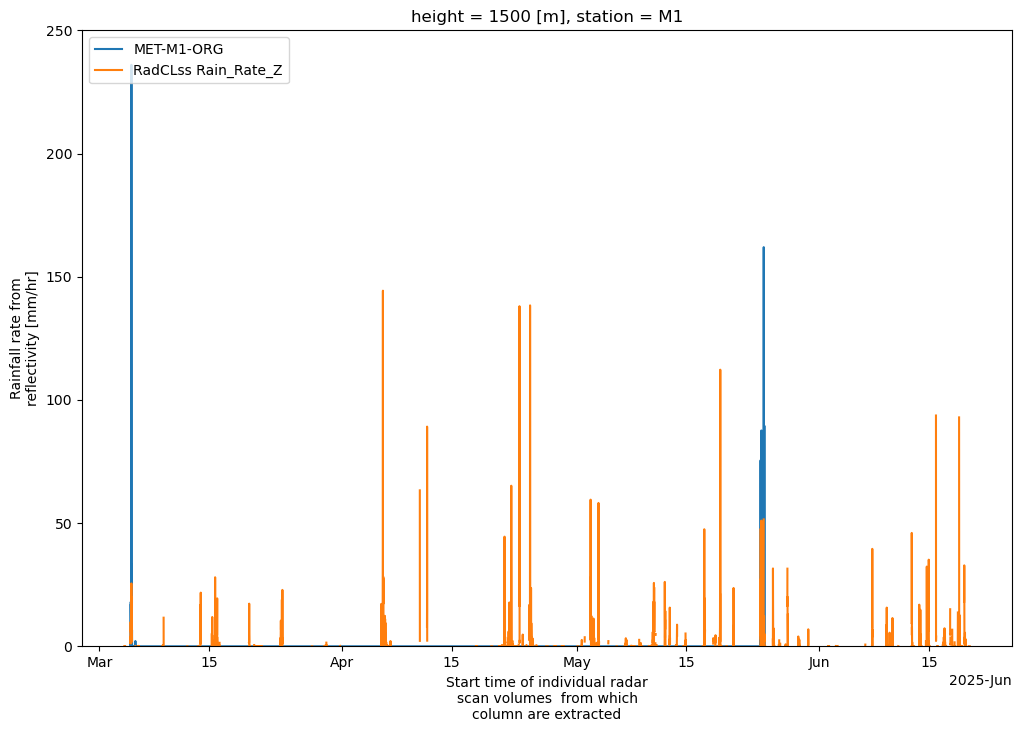
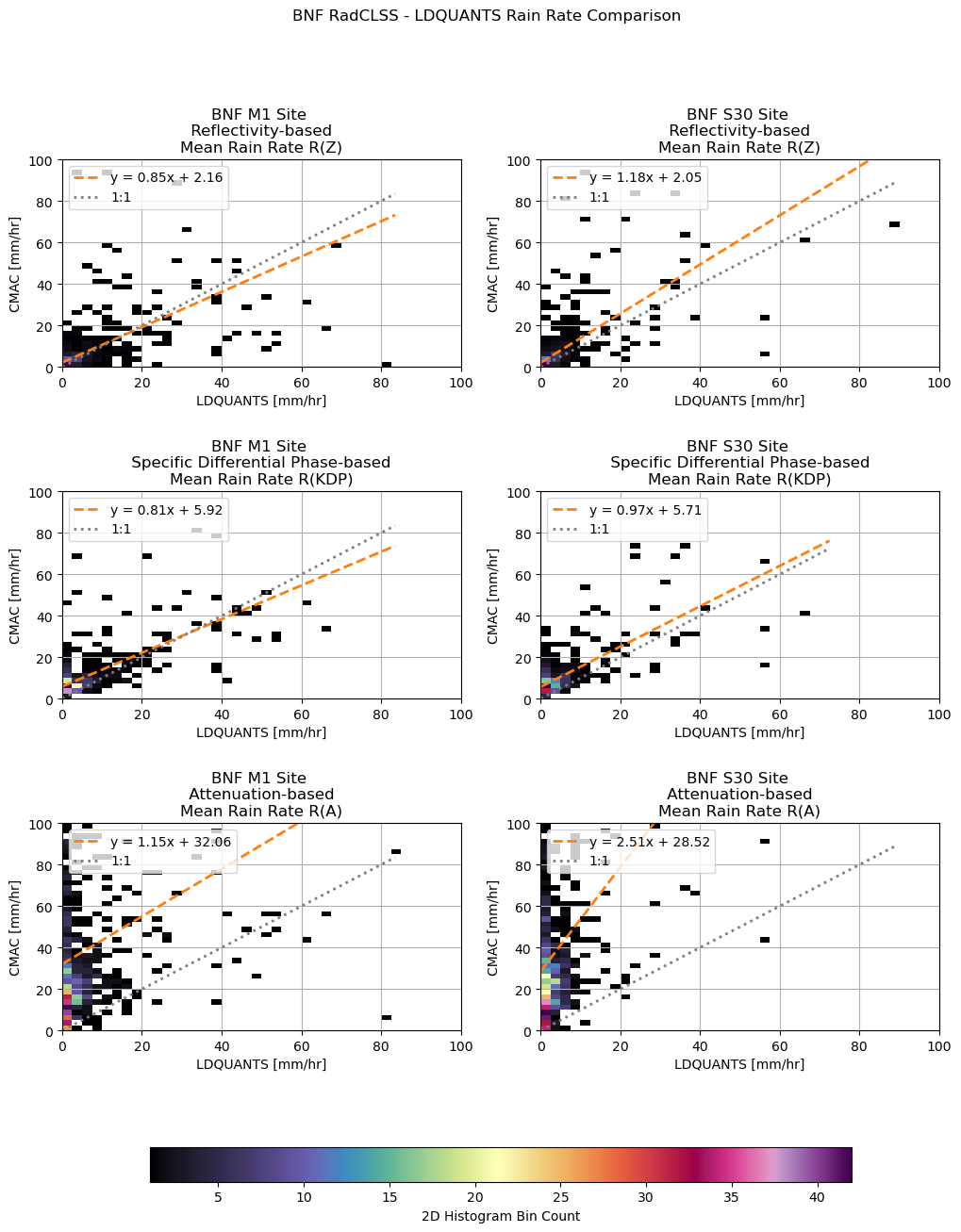
CMAC - LDQUANTS: Rain Rate Comparison
fig, axarr = plt.subplots(3, 2, figsize=[12, 16])
plt.subplots_adjust(wspace=0.2, hspace=0.6)

fig.suptitle("BNF RadCLSS - LDQUANTS Rain Rate Comparison")

ld_parms = {"rain_rate_Z" : [0, 100, "Reflectivity-based \nMean Rain Rate R(Z)"],
            "rain_rate_Kdp" : [0, 100, "Specific Differential Phase-based \nMean Rain Rate R(KDP)"],
            "rain_rate_A" :  [0, 100, "Attenuation-based \nMean Rain Rate R(A)"],
}

i = 0
for parm in ld_parms:
    j = 0
    for site in ds.station.data:
        if site in ["M1", "S30"]:
            print(site, parm)
            if parm != "rain_rate_A":
                mask = (
                        np.isfinite(ds["ldquants_rain_rate"].sel(station=site).data) &
                        np.isfinite(ds[parm].sel(station=site).sel(height=1500, method="nearest").data) &
                        (ds["ldquants_rain_rate"].sel(station=site).data > 0.01) &
                        (ds[parm].sel(station=site).sel(height=1500, method="nearest").data > 0.01)
                    )
            else:
                mask = (
                        np.isfinite(ds["ldquants_rain_rate"].sel(station=site).data) &
                        np.isfinite(ds[parm].sel(station=site).sel(height=1500, method="nearest").data) &
                        (ds["ldquants_rain_rate"].sel(station=site).data > 0.01)
                    )

            h = axarr[i, j].hist2d(ds["ldquants_rain_rate"].sel(station=site).data[mask],
                                   ds[parm].sel(station=site).sel(height=1500, method="nearest").data[mask],
                                   bins=[40, 40],
                                   range=[[0, 100], [0, 100]],
                                   cmap="ChaseSpectral",
                                   cmin=1,
            )

            axarr[i, j].set_title(f"BNF {site} Site \n {ld_parms[parm][2]}")
            axarr[i, j].set_xlim([0, 100])
            axarr[i, j].set_ylim([0, 100])
            axarr[i, j].set_xlabel("LDQUANTS [mm/hr]")
            axarr[i, j].set_ylabel("CMAC [mm/hr]")
            axarr[i, j].grid(True)

            # calculate a linear regression
            slope, intercept, r_value, p_value, std_err = linregress(ds["ldquants_rain_rate"].sel(station=site).data[mask],
                                                                     ds[parm].sel(station=site).sel(height=1500, method="nearest").data[mask])
            x_fit = np.linspace(ds["ldquants_rain_rate"].sel(station=site).data[mask].min(),
                                ds["ldquants_rain_rate"].sel(station=site).data[mask].max(),
                                100)
            y_fit = slope * x_fit + intercept
            # plot the linear regression
            axarr[i, j].plot(x_fit, y_fit, color='tab:orange', linestyle='--', linewidth=2, label=f"y = {slope:.2f}x + {intercept:.2f}")
            # Optional: 1:1 line
            axarr[i, j].plot(x_fit, x_fit, color='tab:gray', linestyle=':', label='1:1', linewidth=2)
            axarr[i, j].legend(loc='upper left')

            j += 1
    i += 1

# Colorbar for histogram bin counts
cbar = fig.colorbar(h[3], ax=axarr, location='bottom', shrink=0.8, pad=0.1)
cbar.set_label("2D Histogram Bin Count")
M1 rain_rate_Z
S30 rain_rate_Z
M1 rain_rate_Kdp
S30 rain_rate_Kdp
M1 rain_rate_A
S30 rain_rate_A
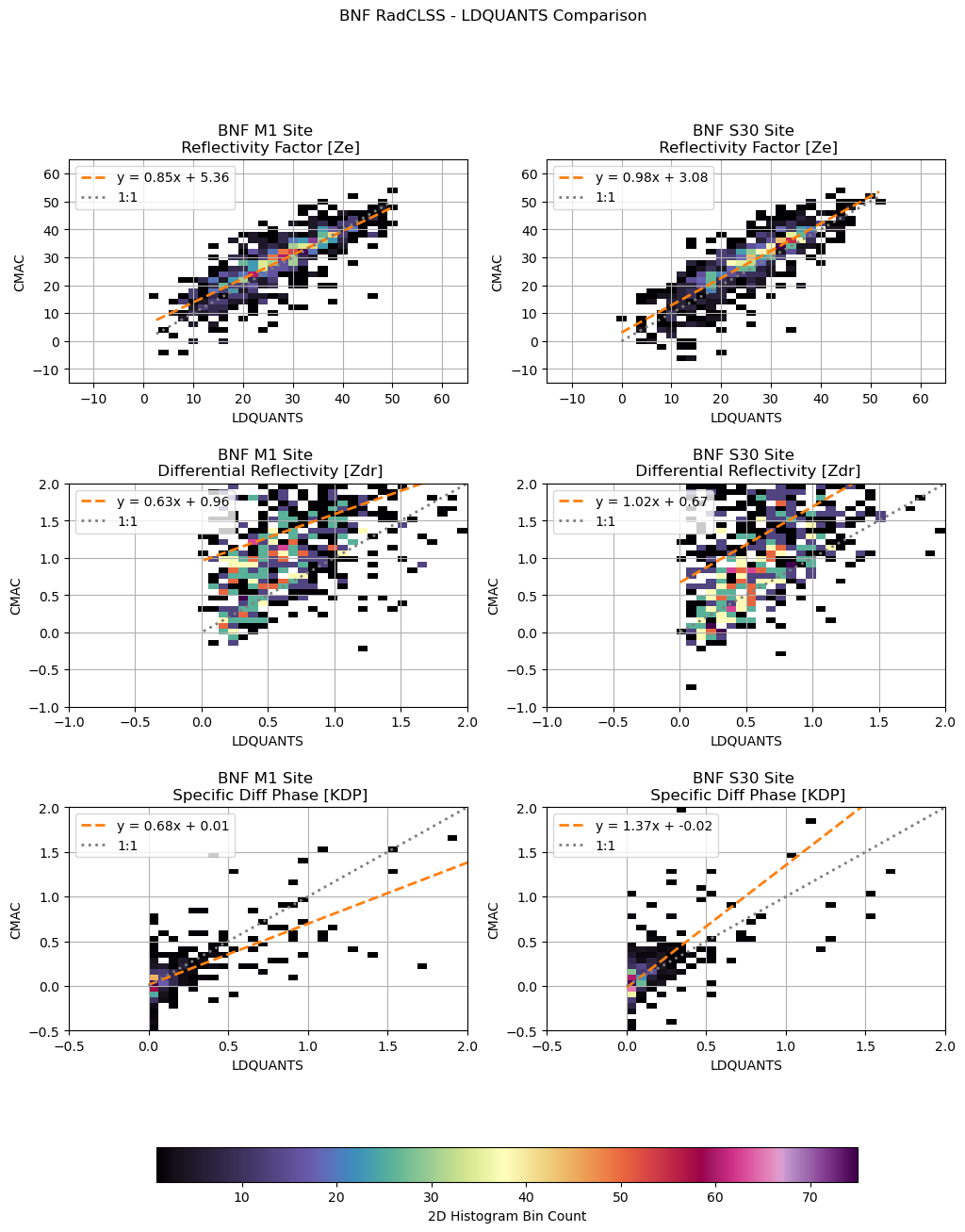
CMAC - LDQUANTS: Radar Parameters Comparison
fig, axarr = plt.subplots(3, 2, figsize=[12, 16])
plt.subplots_adjust(wspace=0.2, hspace=0.45)

fig.suptitle("BNF RadCLSS - LDQUANTS Comparison")

ld_parms = {
    "ldquants_reflectivity_factor_cband20c": ["corrected_reflectivity", -15, 65, "Reflectivity Factor [Ze]"],
    "ldquants_differential_reflectivity_cband20c": ["corrected_differential_reflectivity", -1, 2, "Differential Reflectivity [Zdr]"],
    "ldquants_specific_differential_phase_cband20c": ["corrected_specific_diff_phase", -0.5, 2, "Specific Diff Phase [KDP]"],
}

i = 0
for parm in ld_parms:
    j = 0
    for site in ds.station.data:
        if site in ["M1", "S30"]:
            print(site, parm)
            if parm == "ldquants_specific_differential_phase_cband20c":
                mask = (
                    np.isfinite(ds["ldquants_specific_differential_phase_cband20c"].sel(station=site).data) &
                    np.isfinite(ds["corrected_specific_diff_phase"].sel(station=site).sel(height=1500).data) &
                    (ds["corrected_specific_diff_phase"].sel(station=site).sel(height=1500).data > -10) &
                    (ds["corrected_specific_diff_phase"].sel(station=site).sel(height=1500).data < 10)
                )
            elif parm == "ldquants_differential_reflectivity_cband20c":
                mask = (
                    np.isfinite(ds["ldquants_differential_reflectivity_cband20c"].sel(station=site).data) &
                    np.isfinite(ds["corrected_differential_reflectivity"].sel(station=site).sel(height=1500).data) &
                    (ds["ldquants_differential_reflectivity_cband20c"].sel(station=site).data > -2)
                )
            else:
                mask = (
                    np.isfinite(ds[parm].sel(station=site).data) &
                    np.isfinite(ds[ld_parms[parm][0]].sel(station=site).sel(height=1500, method="nearest").data)
                )

            h = axarr[i, j].hist2d(ds[parm].sel(station=site).data[mask],
                                   ds[ld_parms[parm][0]].sel(station=site).sel(height=1500, method="nearest").data[mask],
                                   bins=[40, 40],
                                   range=[[ld_parms[parm][1], ld_parms[parm][2]], [ld_parms[parm][1], ld_parms[parm][2]]],
                                   cmap="ChaseSpectral",
                                   cmin=1,
            )

            axarr[i, j].set_title(f"BNF {site} Site \n {ld_parms[parm][3]}")
            axarr[i, j].set_xlim([ld_parms[parm][1], ld_parms[parm][2]])
            axarr[i, j].set_ylim([ld_parms[parm][1], ld_parms[parm][2]])
            axarr[i, j].set_xlabel("LDQUANTS")
            axarr[i, j].set_ylabel("CMAC")
            axarr[i, j].grid(True)

            # calculate a linear regression
            slope, intercept, r_value, p_value, std_err = linregress(ds[parm].sel(station=site).data[mask],
                                                                     ds[ld_parms[parm][0]].sel(station=site).sel(height=1500, method="nearest").data[mask])
            x_fit = np.linspace(ds[parm].sel(station=site).data[mask].min(),
                                ds[parm].sel(station=site).data[mask].max(),
                                100)
            y_fit = slope * x_fit + intercept
            # plot the linear regression
            axarr[i, j].plot(x_fit, y_fit, color='tab:orange', linestyle='--', linewidth=2, label=f"y = {slope:.2f}x + {intercept:.2f}")
            # Optional: 1:1 line
            axarr[i, j].plot(x_fit, x_fit, color='tab:gray', linestyle=':', label='1:1', linewidth=2)
            axarr[i, j].legend(loc='upper left')

            j += 1
    i += 1

# Colorbar for histogram bin counts
cbar = fig.colorbar(h[3], ax=axarr, location='bottom', shrink=0.8, pad=0.1)
cbar.set_label("2D Histogram Bin Count")
M1 ldquants_reflectivity_factor_cband20c
S30 ldquants_reflectivity_factor_cband20c
M1 ldquants_differential_reflectivity_cband20c
S30 ldquants_differential_reflectivity_cband20c
M1 ldquants_specific_differential_phase_cband20c
S30 ldquants_specific_differential_phase_cband20c
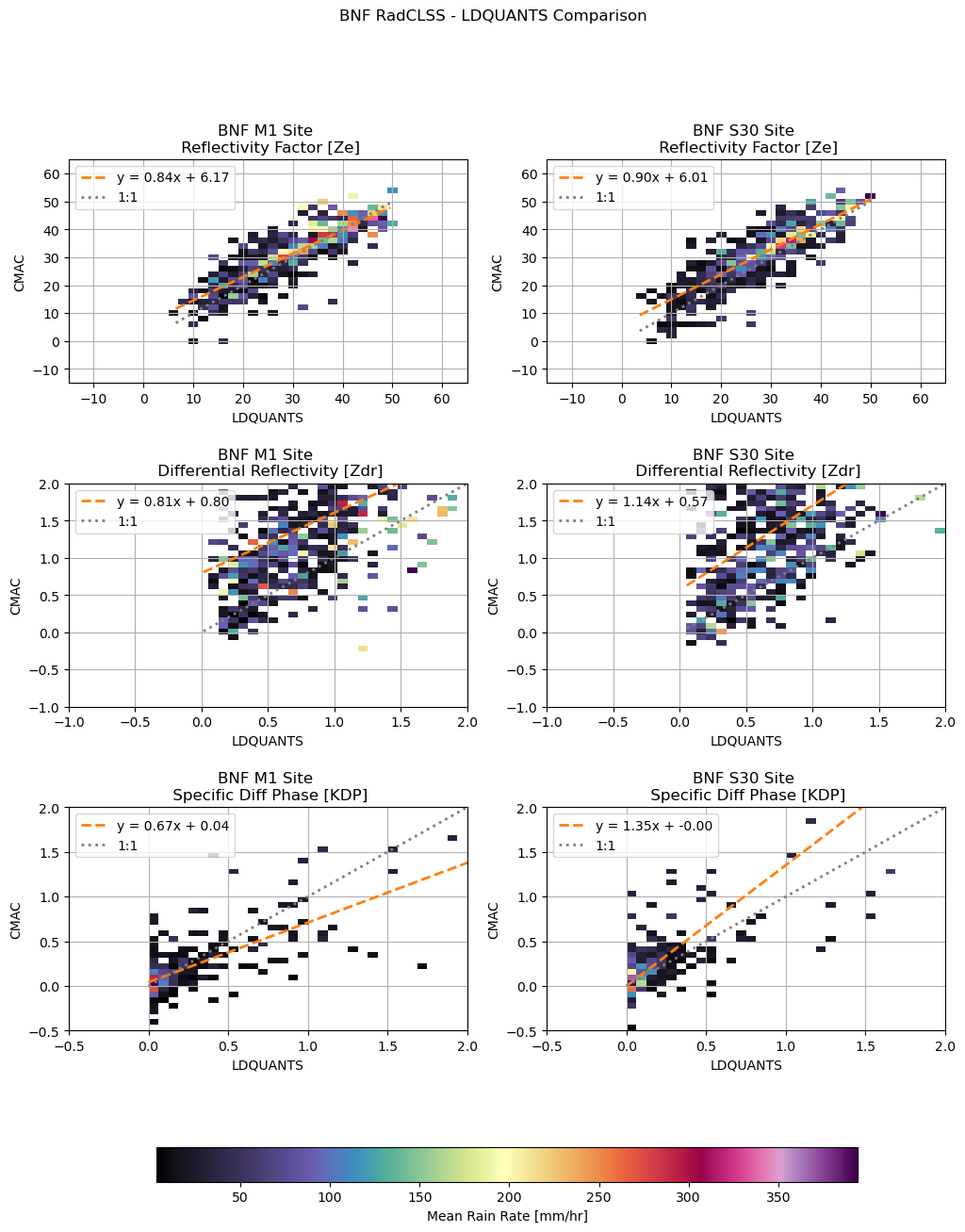
LDQUANTS Comparison with Weights
fig, axarr = plt.subplots(3, 2, figsize=[12, 16])
plt.subplots_adjust(wspace=0.2, hspace=0.45)

fig.suptitle("BNF RadCLSS - LDQUANTS Comparison")

ld_parms = {
    "ldquants_reflectivity_factor_cband20c": ["corrected_reflectivity", -15, 65, "Reflectivity Factor [Ze]"],
    "ldquants_differential_reflectivity_cband20c": ["corrected_differential_reflectivity", -1, 2, "Differential Reflectivity [Zdr]"],
    "ldquants_specific_differential_phase_cband20c": ["corrected_specific_diff_phase", -0.5, 2, "Specific Diff Phase [KDP]"],
}

i = 0
for parm in ld_parms:
    j = 0
    for site in ds.station.data:
        if site in ["M1", "S30"]:
            print(site, parm)
            z = ds.sel(station=site).sel(height=1500).rain_rate_Kdp.values.flatten()
            if parm == "ldquants_specific_differential_phase_cband20c":
                mask = (
                    np.isfinite(ds["ldquants_specific_differential_phase_cband20c"].sel(station=site).data) &
                    np.isfinite(ds["corrected_specific_diff_phase"].sel(station=site).sel(height=1500).data) &
                    (ds["corrected_specific_diff_phase"].sel(station=site).sel(height=1500).data > -10) &
                    (ds["corrected_specific_diff_phase"].sel(station=site).sel(height=1500).data < 10) &
                    np.isfinite(z)
                )
            elif parm == "ldquants_differential_reflectivity_cband20c":
                mask = (
                    np.isfinite(ds["ldquants_differential_reflectivity_cband20c"].sel(station=site).data) &
                    np.isfinite(ds["corrected_differential_reflectivity"].sel(station=site).sel(height=1500).data) &
                    (ds["ldquants_differential_reflectivity_cband20c"].sel(station=site).data > -2) &
                    np.isfinite(z)
                )
            else:
                mask = (
                    np.isfinite(ds[parm].sel(station=site).data) &
                    np.isfinite(ds[ld_parms[parm][0]].sel(station=site).sel(height=1500, method="nearest").data) &
                    np.isfinite(z)
                )

            h = axarr[i, j].hist2d(ds[parm].sel(station=site).data[mask],
                                   ds[ld_parms[parm][0]].sel(station=site).sel(height=1500, method="nearest").data[mask],
                                   weights=z[mask],
                                   bins=[40, 40],
                                   range=[[ld_parms[parm][1], ld_parms[parm][2]], [ld_parms[parm][1], ld_parms[parm][2]]],
                                   cmap="ChaseSpectral",
                                   cmin=1,
            )

            axarr[i, j].set_title(f"BNF {site} Site \n {ld_parms[parm][3]}")
            axarr[i, j].set_xlim([ld_parms[parm][1], ld_parms[parm][2]])
            axarr[i, j].set_ylim([ld_parms[parm][1], ld_parms[parm][2]])
            axarr[i, j].set_xlabel("LDQUANTS")
            axarr[i, j].set_ylabel("CMAC")
            axarr[i, j].grid(True)

            # calculate a linear regression
            slope, intercept, r_value, p_value, std_err = linregress(ds[parm].sel(station=site).data[mask],
                                                                     ds[ld_parms[parm][0]].sel(station=site).sel(height=1500, method="nearest").data[mask])
            x_fit = np.linspace(ds[parm].sel(station=site).data[mask].min(),
                                ds[parm].sel(station=site).data[mask].max(),
                                100)
            y_fit = slope * x_fit + intercept
            # plot the linear regression
            axarr[i, j].plot(x_fit, y_fit, color='tab:orange', linestyle='--', linewidth=2, label=f"y = {slope:.2f}x + {intercept:.2f}")
            # Optional: 1:1 line
            axarr[i, j].plot(x_fit, x_fit, color='tab:gray', linestyle=':', label='1:1', linewidth=2)
            axarr[i, j].legend(loc='upper left')

            j += 1
    i += 1

# Colorbar for histogram bin counts
cbar = fig.colorbar(h[3], ax=axarr, location='bottom', shrink=0.8, pad=0.1)
cbar.set_label("Mean Rain Rate [mm/hr]")
M1 ldquants_reflectivity_factor_cband20c
S30 ldquants_reflectivity_factor_cband20c
M1 ldquants_differential_reflectivity_cband20c
S30 ldquants_differential_reflectivity_cband20c
M1 ldquants_specific_differential_phase_cband20c
S30 ldquants_specific_differential_phase_cband20c
from scipy.stats import linregress

# ------------------------------
# A)-- 2D Histogram with Counts
# ------------------------------
mask = np.isfinite(ds["ldquants_reflectivity_factor_cband20c"].sel(station="M1").data) & np.isfinite(ds['corrected_reflectivity'].sel(station="M1").sel(height=1500).data)

fig, axarr = plt.subplots(1, 2, figsize=[14, 7])

h = axarr[0].hist2d(ds["ldquants_reflectivity_factor_cband20c"].sel(station="M1").data[mask],
                    ds['corrected_reflectivity'].sel(station="M1").sel(height=1500).data[mask],
                    bins=[80, 80],
                    range=[[-15, 65], [-15, 65]],
                    cmap="ChaseSpectral",
                    cmin=1
)

axarr[0].set_title("2D Histogram")
axarr[0].set_xlim([-15, 65])
axarr[0].set_ylim([-15, 65])
axarr[0].set_xlabel("LDQUANTS")
axarr[0].set_ylabel("CMAC")
axarr[0].grid(True)
fig.colorbar(h[3], ax=axarr[0], location="bottom", shrink=0.8, pad=0.1, label="2D Histogram Bin Counts")

# calculate a linear regression
slope, intercept, r_value, p_value, std_err = linregress(ds["ldquants_reflectivity_factor_cband20c"].sel(station="M1").data[mask],
                                                         ds['corrected_reflectivity'].sel(station="M1").sel(height=1500).data[mask])
x_fit = np.linspace(ds["ldquants_reflectivity_factor_cband20c"].sel(station="M1").data[mask].min(),
                    ds["ldquants_reflectivity_factor_cband20c"].sel(station="M1").data[mask].max(),
                    100)
y_fit = slope * x_fit + intercept
# plot the linear regression
axarr[0].plot(x_fit, y_fit, color='tab:orange', linestyle='--', linewidth=3, label=f"y = {slope:.2f}x + {intercept:.2f}")
# Optional: 1:1 line
axarr[0].plot(x_fit, x_fit, color='tab:gray', linestyle=':', label='1:1', linewidth=2)
axarr[0].legend(loc='upper left')

#----------------------------
# B) - Weighted 2D Histogram
#----------------------------

z = ds.sel(station="M1").sel(height=1500).rain_rate_Kdp.values.flatten()
z_mask = np.isfinite(ds["ldquants_reflectivity_factor_cband20c"].sel(station="M1").data) & np.isfinite(ds['corrected_reflectivity'].sel(station="M1").sel(height=1500).data) & np.isfinite(z)

h = axarr[1].hist2d(ds["ldquants_reflectivity_factor_cband20c"].sel(station="M1").data[mask],
                    ds['corrected_reflectivity'].sel(station="M1").sel(height=1500).data[mask],
                    weights=z[mask],
                    bins=[80, 80],
                    range=[[-15, 65], [-15, 65]],
                    cmap="ChaseSpectral",
                    cmin=1,
)

axarr[1].set_title("2D Histogram with Weights")
axarr[1].set_xlim([-15, 65])
axarr[1].set_ylim([-15, 65])
axarr[1].set_xlabel("LDQUANTS")
axarr[1].set_ylabel("CMAC")
axarr[1].grid(True)
fig.colorbar(h[3], ax=axarr[1], location="bottom", shrink=0.8, pad=0.1, label="Mean Rain Rate [mm/hr]")

# calculate a linear regression
slope, intercept, r_value, p_value, std_err = linregress(ds["ldquants_reflectivity_factor_cband20c"].sel(station="M1").data[z_mask],
                                                         ds['corrected_reflectivity'].sel(station="M1").sel(height=1500).data[z_mask])
x_fit = np.linspace(ds["ldquants_reflectivity_factor_cband20c"].sel(station="M1").data[z_mask].min(),
                    ds["ldquants_reflectivity_factor_cband20c"].sel(station="M1").data[z_mask].max(),
                    100)
y_fit = slope * x_fit + intercept
# plot the linear regression
axarr[1].plot(x_fit, y_fit, color='tab:orange', linestyle='--', linewidth=3, label=f"y = {slope:.2f}x + {intercept:.2f}")
# Optional: 1:1 line
axarr[1].plot(x_fit, x_fit, color='tab:gray', linestyle=':', label='1:1', linewidth=2)
axarr[1].legend(loc='upper left')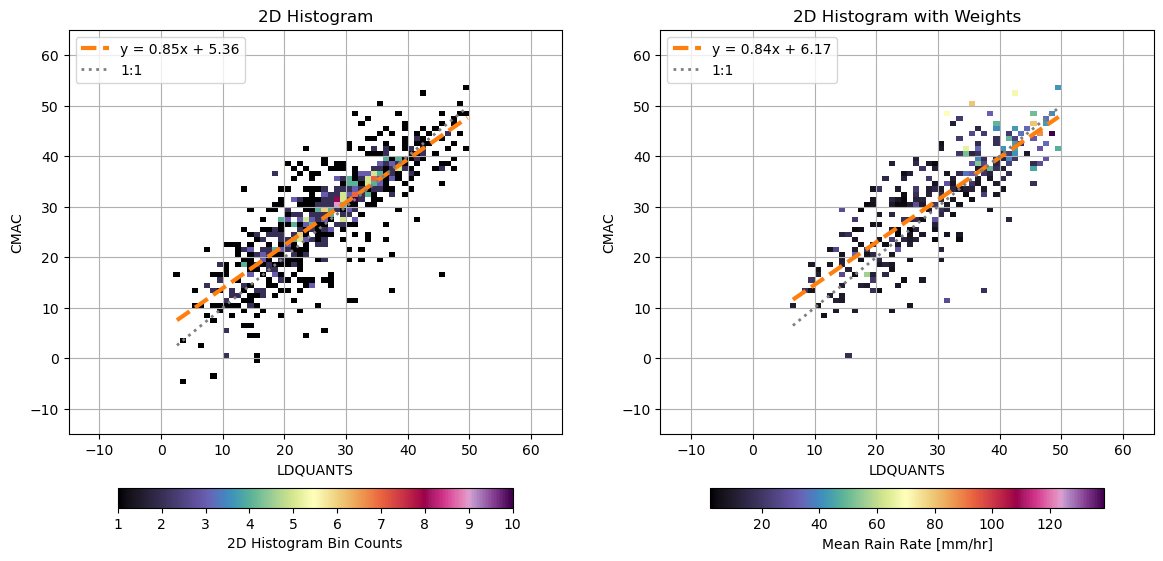
dsZ-R Fit Analysis
def linear_regress_fit(parm_y, rain_rate):
    """
    calculate the linear regression for the specific radar variable vs rain rate
    """
    # Generate the mask
    ld_mask = (np.isfinite(parm_y) &
               np.isfinite(rain_rate) &
               (rain_rate > 0.01)
    )

    Z_linear = 10**(parm_y[ld_mask] / 10) # Z in mm^6 m^-3
    log_Z = np.log10(Z_linear) # Take log10 of Z
    log_R = np.log10(rain_rate[ld_mask]) # Take log10 of rain rate

    coefficients_zr = np.polyfit(log_R, log_Z, 1) # Linear fit: log(Z) = b*log(R) + log(a)
    print(f"coefficients_zr (raw from np.polyfit): {coefficients_zr}")
    b_coefficient = coefficients_zr[0] # Slope
    log_a_coefficient = coefficients_zr[1] # Intercept
    a_coefficient = 10**log_a_coefficient # Convert to a

    print(f"Relationship for C-band (from LDQUANTS or CMAC data):")
    print(f"Z = {a_coefficient:.2f} * R**{b_coefficient:.2f}") # Z = a * R^b

    return a_coefficient, b_coefficient
# Need to mask the rain rates
cmac_mask = (np.isfinite(ds.sel(station="S30").sel(height=1500, method="nearest").rain_rate_Z.data) &
np.isfinite(ds.sel(station="S30").sel(height=1500, method="nearest").corrected_reflectivity.data) &
(ds.sel(station="S30").sel(height=1500, method="nearest").rain_rate_Z.data > 0.01)
)
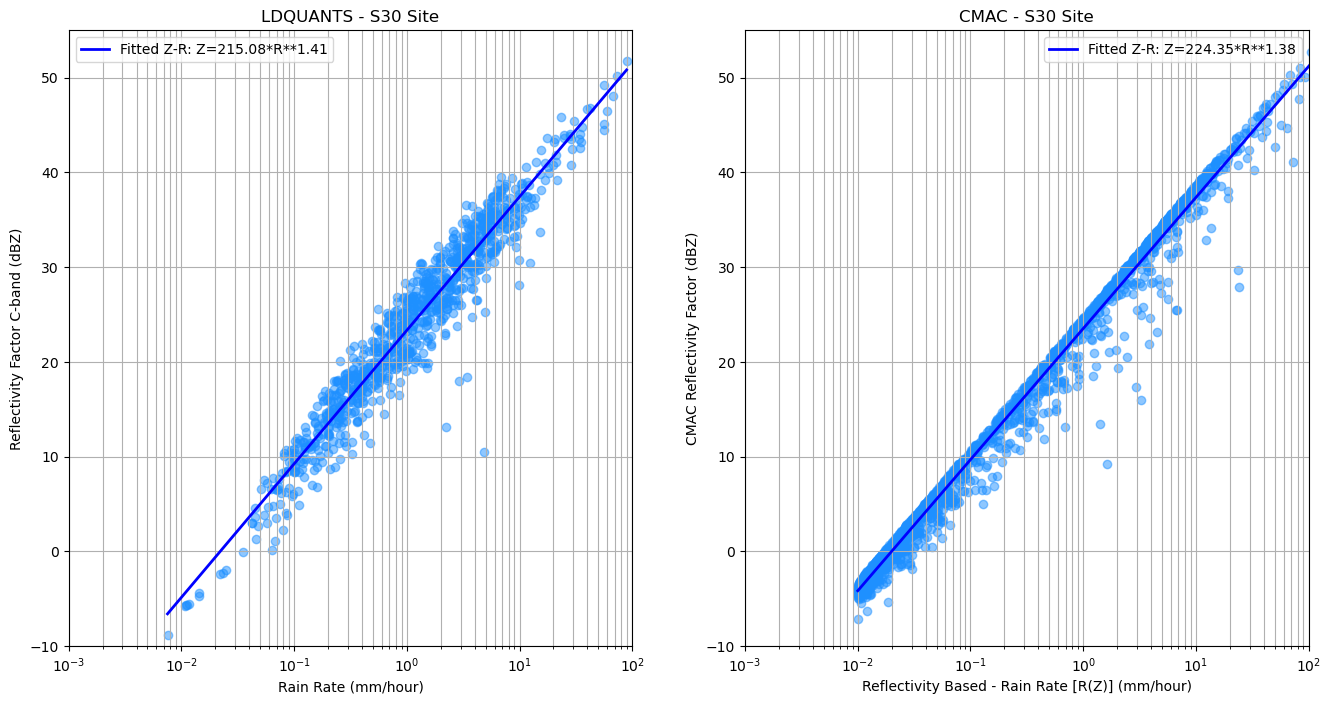
fig, axs = plt.subplots(1, 2, figsize=(16, 8))
axs[0].scatter(ds.sel(station="S30").ldquants_rain_rate.data,
ds.sel(station="S30").ldquants_reflectivity_factor_cband20c.data,
alpha=0.5,
color='dodgerblue')
axs[0].set_xlabel('Rain Rate (mm/hour)')
axs[0].set_ylabel('Reflectivity Factor C-band (dBZ)')
axs[0].set_xscale('log') # Logarithmic scale for rain rate
axs[0].set_yscale('linear')
axs[0].set_ylim([-10, 55])
axs[0].set_xlim([1e-3, 1e2])
axs[0].set_title("LDQUANTS - S30 Site")
axs[0].grid(True, which="both", ls="-")
# Add the fitted Z-R line
rain_rate_line = np.logspace(np.log10(np.nanmin(ds.sel(station="S30").ldquants_rain_rate.data)), np.log10(np.nanmax(ds.sel(station="S30").ldquants_rain_rate.data)), 100)
a_coeff, b_coeff = linear_regress_fit(ds["ldquants_reflectivity_factor_cband20c"].sel(station="S30").data,
ds["ldquants_rain_rate"].sel(station="S30").data)
Z_linear_line = a_coeff * (rain_rate_line**b_coeff)
reflectivity_dbz_line = 10 * np.log10(Z_linear_line)
axs[0].plot(rain_rate_line, reflectivity_dbz_line, color='blue', linewidth=2, label=f'Fitted Z-R: Z={a_coeff:.2f}*R**{b_coeff:.2f}')
axs[0].legend(loc="upper left")
axs[1].scatter(ds.sel(station="S30").sel(height=1500, method="nearest").rain_rate_Z.data[cmac_mask],
ds.sel(station="S30").sel(height=1500, method="nearest").corrected_reflectivity.data[cmac_mask],
alpha=0.5,
color='dodgerblue')
axs[1].set_xlabel('Reflectivity Based - Rain Rate [R(Z)] (mm/hour)')
axs[1].set_ylabel('CMAC Reflectivity Factor (dBZ)')
axs[1].set_xscale('log') # Logarithmic scale for rain rate
axs[1].set_yscale('linear')
axs[1].set_ylim([-10, 55])
axs[1].set_xlim([1e-3, 1e2])
axs[1].set_title("CMAC - S30 Site")
axs[1].grid(True, which="both", ls="-")
rain_rate_line_c = np.logspace(np.log10(np.nanmin(ds.sel(station="S30").sel(height=1500, method="nearest").rain_rate_Z.data[cmac_mask])),
np.log10(np.nanmax(ds.sel(station="S30").sel(height=1500, method="nearest").rain_rate_Z.data[cmac_mask])),
100)
a_coeff_c, b_coeff_c = linear_regress_fit(ds.sel(station="S30").sel(height=1500, method="nearest").corrected_reflectivity.data[cmac_mask],
ds.sel(station="S30").sel(height=1500, method="nearest").rain_rate_Z.data[cmac_mask])
Z_linear_line_c = a_coeff_c * (rain_rate_line_c**b_coeff_c)
reflectivity_dbz_line_c = 10 * np.log10(Z_linear_line_c)
axs[1].plot(rain_rate_line_c, reflectivity_dbz_line_c, color='blue', linewidth=2, label=f'Fitted Z-R: Z={a_coeff_c:.2f}*R**{b_coeff_c:.2f}')
axs[1].legend(loc="upper left")
plt.legend()
plt.show()coefficients_zr (raw from np.polyfit): [1.40931932 2.33259719]
Relationship for C-band (from LDQUANTS or CMAC data):
Z = 215.08 * R**1.41
coefficients_zr (raw from np.polyfit): [1.38350247 2.35092099]
Relationship for C-band (from LDQUANTS or CMAC data):
Z = 224.35 * R**1.38
References
Surface Meteorological Instrumentation (MET)
Kyrouac, J., Shi, Y., & Tuftedal, M. Surface Meteorological Instrumentation (MET), 2025-03-05 to 2025-03-05, Bankhead National Forest, AL, USA; Long-term Mobile Facility (BNF), Bankhead National Forest, AL, AMF3 (Main Site) (M1). Atmospheric Radiation Measurement (ARM) User Facility. Kyrouac et al. (2021)
Kyrouac, J., Shi, Y., & Tuftedal, M. Surface Meteorological Instrumentation (MET), 2025-03-05 to 2025-03-05, Bankhead National Forest, AL, USA; Long-term Mobile Facility (BNF), Bankhead National Forest, AL, Supplemental facility at Courtland (S20). Atmospheric Radiation Measurement (ARM) User Facility. Kyrouac et al. (2021)
Kyrouac, J., Shi, Y., & Tuftedal, M. Surface Meteorological Instrumentation (MET), 2025-03-05 to 2025-03-05, Bankhead National Forest, AL, USA; Long-term Mobile Facility (BNF), Bankhead National Forest, AL, Supplemental facility at Falkville (S30). Atmospheric Radiation Measurement (ARM) User Facility. Kyrouac et al. (2021)
Kyrouac, J., Shi, Y., & Tuftedal, M. Surface Meteorological Instrumentation (MET), 2025-03-05 to 2025-03-05, Bankhead National Forest, AL, USA; Long-term Mobile Facility (BNF), Bankhead National Forest, AL, Supplemental facility at Double Springs (S40). Atmospheric Radiation Measurement (ARM) User Facility. Kyrouac et al. (2021)
Balloon-Borne Sounding System (SONDEWNPN)
Keeler, E., Burk, K., & Kyrouac, J. Balloon-Borne Sounding System (SONDEWNPN), 2025-03-05 to 2025-03-05, Bankhead National Forest, AL, USA; Long-term Mobile Facility (BNF), Bankhead National Forest, AL, AMF3 (Main Site) (M1). Atmospheric Radiation Measurement (ARM) User Facility. Keeler et al. (2022)
Weighing Bucket Preciptiation Gauge (WBPLUVIO2)
Zhu, Z., Wang, D., Jane, M., Cromwell, E., Sturm, M., Irving, K., & Delamere, J. Weighing Bucket Precipitation Gauge (WBPLUVIO2), 2025-03-05 to 2025-03-05, Bankhead National Forest, AL, USA; Long-term Mobile Facility (BNF), Bankhead National Forest, AL, AMF3 (Main Site) (M1). Atmospheric Radiation Measurement (ARM) User Facility. Zhu et al. (2016)
Laser Disdrometer Quantities (LDQUANTS)
Hardin, J., Giangrande, S., & Zhou, A. Laser Disdrometer Quantities (LDQUANTS), 2025-03-05 to 2025-03-05, Bankhead National Forest, AL, USA; Long-term Mobile Facility (BNF), Bankhead National Forest, AL, AMF3 (Main Site) (M1). Atmospheric Radiation Measurement (ARM) User Facility. Hardin et al. (2019)
Hardin, J., Giangrande, S., & Zhou, A. Laser Disdrometer Quantities (LDQUANTS), 2025-03-05 to 2025-03-05, Bankhead National Forest, AL, USA; Long-term Mobile Facility (BNF), Bankhead National Forest, AL, Supplemental facility at Falkville (S30). Atmospheric Radiation Measurement (ARM) User Facility. Hardin et al. (2019)
- Kyrouac, J., Shi, Y., & Tuftedal, M. (2021). met.b1. Atmospheric Radiation Measurement (ARM) Archive, Oak Ridge National Laboratory (ORNL), Oak Ridge, TN (US); ARM Data Center, Oak Ridge National Laboratory (ORNL), Oak Ridge, TN (United States). 10.5439/1786358
- Keeler, E., Burk, K., & Kyrouac, J. (2022). Balloon-borne sounding system (BBSS), WNPN output data. Atmospheric Radiation Measurement (ARM) Archive, Oak Ridge National Laboratory (ORNL), Oak Ridge, TN (US); ARM Data Center, Oak Ridge National Laboratory (ORNL), Oak Ridge, TN (United States). 10.5439/1595321
- Zhu, Z., Wang, D., Jane, M., Cromwell, E., Sturm, M., Irving, K., & Delamere, J. (2016). wbpluvio2.a1. Atmospheric Radiation Measurement (ARM) Archive, Oak Ridge National Laboratory (ORNL), Oak Ridge, TN (US); ARM Data Center, Oak Ridge National Laboratory (ORNL), Oak Ridge, TN (United States). 10.5439/1338194
- Hardin, J., Giangrande, S., & Zhou, A. (2019). ldquants. Atmospheric Radiation Measurement (ARM) Archive, Oak Ridge National Laboratory (ORNL), Oak Ridge, TN (US); ARM Data Center, Oak Ridge National Laboratory (ORNL), Oak Ridge, TN (United States). 10.5439/1432694